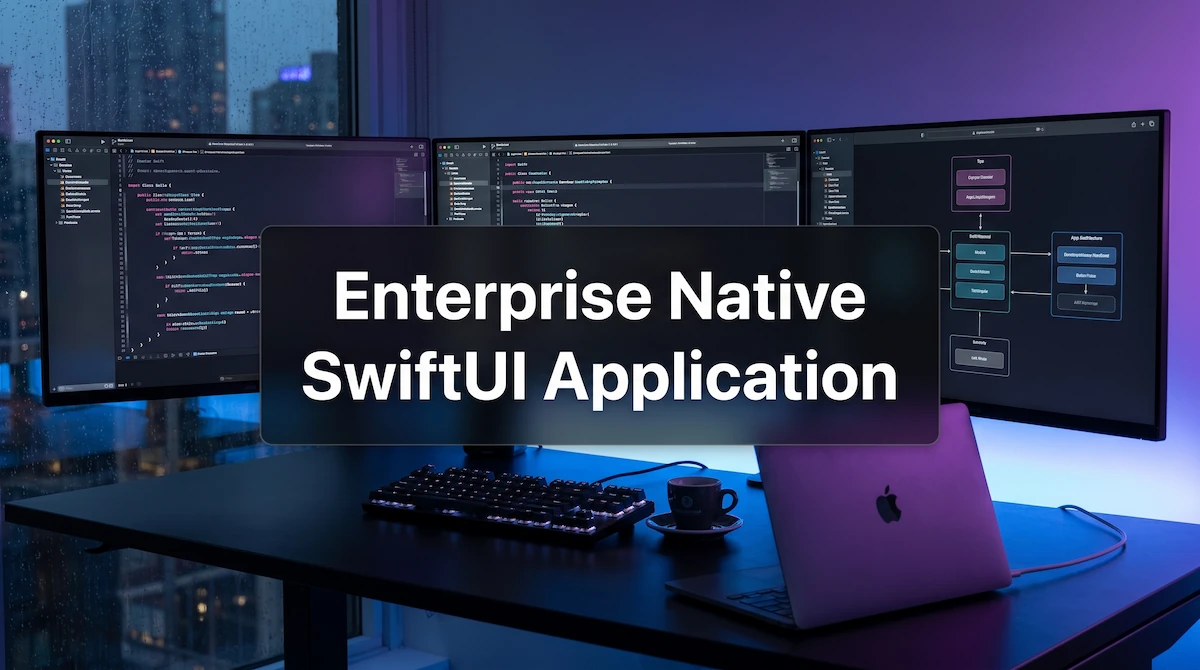
Building a Production-Ready Enterprise SwiftUI Application
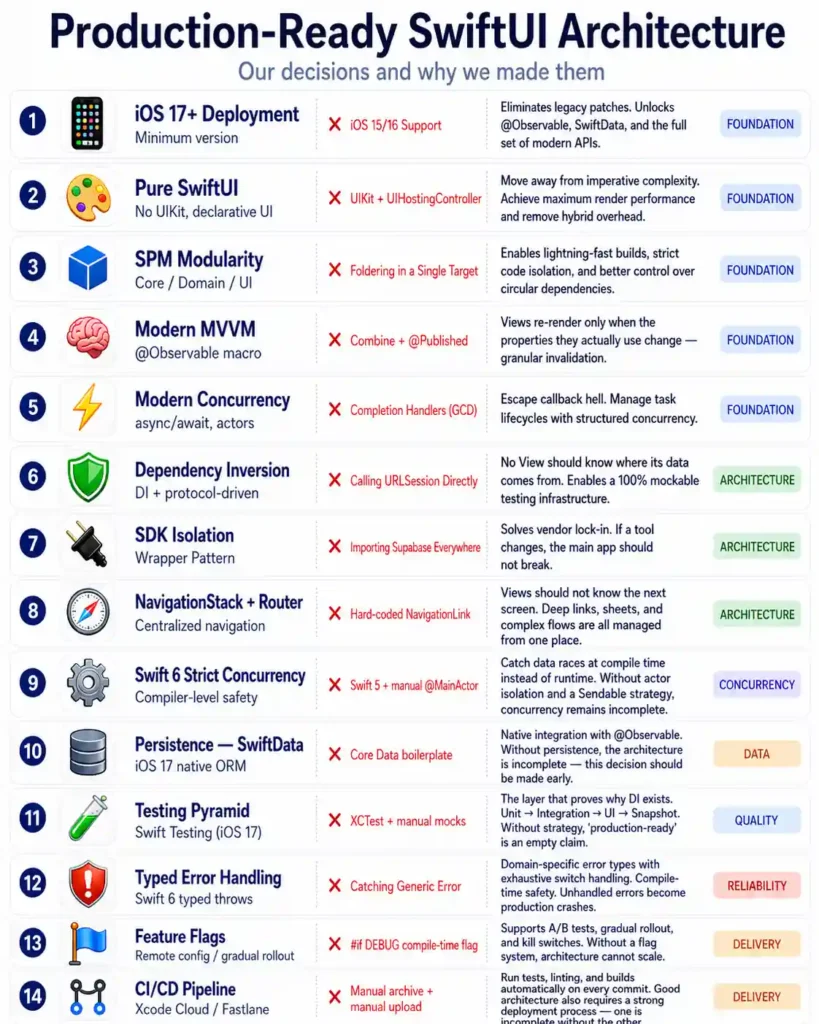
If you are building a production-ready, enterprise native SwiftUI application, the following architectural decisions are absolute non-negotiables.
The Non-Negotiable Checklist
- iOS 17+ & Pure SwiftUI: You shed legacy patches and unlock the full spectrum of modern APIs.
- SPM Core / Domain / UI Modularity: Build times drop significantly. Isolated layers prevent developers from breaking each other’s code. If you want to optimize this further, mastering iOS static framework architecture is critical for keeping your application incredibly performant.
- Modern MVVM: Utilizing
@Observableinstead of Combine ensures a view only renders when the exact property it reads changes. This approach is a massive leap forward from the days of complex Swift property wrappers managing every minor state update. - Modern Concurrency: Adopting
async/awaitand structured tasks kills callback hell and makes task lifecycles highly manageable. - Dependency Inversion: Views remain completely unaware of concrete services. Everything becomes mockable and testable. You can dive much deeper into how to structure this cleanly in my guide on Dependency Injection and IoC in Swift.
- SDK Isolation: Third-party libraries are trapped inside wrappers. Your app survives when a vendor changes their tool tomorrow.
- NavigationStack + Central Router: Deep links, sheets, and complex flows are strictly managed from a single source of truth.
- Swift 6 Strict Concurrency: Data races are caught at the compiler level rather than blowing up at runtime.
- SwiftData: Natively integrates with
@Observableand completely eradicates Core Data boilerplate. - Testing Pyramid: This is where the effort of decoupling your code pays off. You move from Unit to Integration, UI, and Snapshot testing using Swift Testing.
- Typed Error Handling: Using domain-specific types and exhaustive switch statements forces you to handle every error scenario at compile-time.
- Feature Flags: You cannot manage a growing application without kill switches, A/B testing, and gradual rollouts.
- CI/CD Pipeline: Automated tests, linting, and builds run on every commit. Great architecture is useless without great deployment mechanics.
Why We Enforce These Standards
You might wonder why these specific rules are so rigid. Building scalable software requires defensive programming and a foundation that anticipates change.
Shielding the Core Domain
SDK Isolation and Dependency Inversion exist to protect your business logic. Vendors deprecate tools. APIs change. By hiding third-party code behind protocols, you limit the blast radius of a migration to a single file rather than hundreds of views. The testing pyramid naturally falls into place because decoupled code is inherently testable code.
Eradicating State and Threading Bugs
State inconsistencies and data races are the hardest bugs to track down in production. Moving to Swift 6 Strict Concurrency forces thread safety to be a compile-time guarantee. Coupling this with the @Observable macro means the state binding is precise. We abandon Combine because the new macro system is highly optimized and prevents the massive view recalculations that plague older SwiftUI apps.
Developer Velocity and Scale
Monoliths slow down teams. Splitting the app into local Swift Packages for Core, Domain, and UI layers allows Xcode to cache builds aggressively. When your team grows, developers can work on isolated packages without creating merge conflicts in a massive central project file. Feature flags and a strict CI/CD pipeline act as the ultimate safety net, ensuring that fast-paced, concurrent development never breaks your release candidate.